Seme Comparison Analysis
By Seme Research Team · Updated May 22, 2026
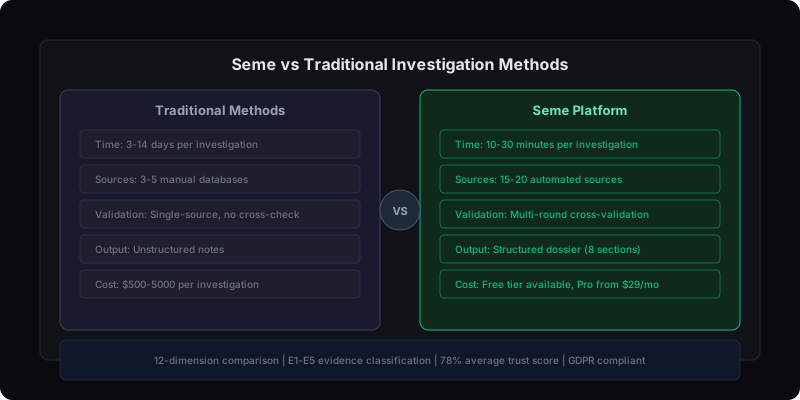
Seme vs Traditional Methods
The following comparison shows how Seme differs from traditional background check methods, LinkedIn search, and manual OSINT investigation across 12 key dimensions.
| Dimension | Traditional | OSINT | Seme | |
|---|---|---|---|---|
| Data Sources | 1-3 databases | LinkedIn only | 5-10 manual sources | 15-20 automated sources |
| Verification | Single source | User-provided | Manual cross-reference | AI cross-validation |
| Evidence Classification | No standard | None | Analyst judgment | E1-E5 five-tier system |
| Trust Score | None | None | No standard | 0-100% quantified |
| Investigation Time | Days to weeks | Instant (profile only) | Hours | 10-30 minutes |
| Output Format | Unstructured report | Profile page | Manual document | Structured dossier + graph |
| Social Profile Coverage | Limited | LinkedIn only | Manual collection | Multi-platform auto-discovery |
| Relationship Graph | None | 1st connections only | Manual drawing | Auto force-directed graph |
| Timeline | None | Work history only | Manual assembly | Auto-generated timeline |
| Auditability | Low | Not auditable | Moderate | High (every fact sourced) |
| API Integration | Limited | Restricted API | No standard | REST API + Agent workflows |
| Multi-Language | Limited | Multi-language | Analyst-dependent | Bilingual (EN/ZH) |
Tool Comparison
Feature comparison of Seme against major identity investigation and OSINT tools on the market.
| Tool | Type | Sources | Time | Evidence | Trust | API |
|---|---|---|---|---|---|---|
| Seme | AI Investigation | 15-20 | 10-30 min | E1-E5 | 0-100% | Full REST API |
| Pipl | People Search | 3-5 | Instant | None | None | Yes |
| Maltego | OSINT Visualization | 10+ | Hours | No standard | None | Limited |
| Spokeo | Consumer Search | 2-3 | Instant | None | None | None |
| LinkedIn Recruiter | Recruitment | 1 | Instant | None | None | Restricted |
| Traditional PI Firm | Manual Investigation | 3-5 | Days | No standard | None | None |
Investigation Time Comparison
Feature Coverage Comparison
Key Advantages
Multi-Source Automated Investigation
Seme automatically collects from 15-20 independent sources, while traditional methods rely on 1-3 databases and manual OSINT requires analyst-by-analyst collection.
Cross-Validation & Evidence Classification
Every fact is cross-validated across sources and classified E1-E5. Traditional methods and LinkedIn provide no verification or classification.
Quantified Trust Score
0-100% trust score calculated from source quality, cross-validation rate, and information completeness — a quantifiable confidence metric.
Structured Output
Complete dossier with eight components: background, work experience, social profiles, connections, timeline, relationship graph, evidence sources, and trust score.
Deep Comparison: Seme vs Traditional Background Checks
Traditional background check companies typically use 1-3 commercial databases (such as LexisNexis, Accurint) and generate reports through manual review. The entire process takes 3-10 business days and costs between $50-$500. Key limitations include: single data source, inability to verify social media information, inability to build relationship graphs, and non-standardized report formats. In contrast, Seme uses AI-driven multi-round search to automatically collect data from 15-20 independent sources, including public records, academic databases, news archives, social platforms, and corporate registries. Every fact is cross-validated and classified using the E1-E5 five-tier evidence system.
In terms of verification capabilities, traditional methods rely on single-database matching, which is prone to name confusion (false positives) or omissions (false negatives). Seme significantly reduces false positive rates through multi-source cross-validation — when the same fact is confirmed by 3+ independent sources, the evidence level automatically elevates to E1 (highest). The platform's average trust score is 78%, meaning most investigation results are corroborated by multiple independent sources. For scenarios requiring higher confidence (such as financial compliance, legal proceedings), the system supports manually adding additional search rounds to further improve verification coverage.
From a cost-benefit perspective, traditional investigation firms charge $50-$500 per investigation and require 3-10 business days. Seme's credit-based pricing model reduces per-investigation costs to $2-$10, with investigation time shortened to 10-30 minutes. For batch investigation scenarios (such as recruitment screening, supply chain due diligence), Seme's API integration supports automated workflows, further reducing manual costs. The platform provides a complete REST API and Agent workflow interface, supporting seamless integration with existing HR systems, compliance tools, and CRM platforms.
Deep Comparison: Seme vs LinkedIn Recruiter
LinkedIn Recruiter is one of the most widely used recruitment tools globally, with over 900 million member profiles. Its strength lies in the social graph within the platform and real-time updated profile data. However, LinkedIn's data relies entirely on user self-reporting, with no way to verify accuracy. Fake profiles, outdated information, and selective self-presentation are the main limitations of LinkedIn data. Additionally, LinkedIn only covers information within its platform and cannot access public records, academic publications, news reports, or data from other social platforms.
The core difference between Seme and LinkedIn is verification capability. Seme not only collects LinkedIn profile data but also cross-validates education backgrounds (through university websites, academic databases), work history (through corporate registries, news reports), professional qualifications (through certification body databases), and more. Each verification result has traceable source links and evidence level annotations. Additionally, Seme's relationship graph feature can discover hidden relationships beyond LinkedIn's first-degree connections — by analyzing co-authored projects, co-published papers, co-attended events, and more, building a more comprehensive personal relationship network.
Recommended Use Cases
Choose Seme
- •Need multi-source cross-validation
- •Need evidence classification and trust scores
- •Need relationship graphs and timelines
- •Need API integration for automation
- •Batch investigation needs
- •Compliance audit requirements
Choose LinkedIn
- •Quick profile lookup only
- •Social recruiting and networking
- •Brand building and content marketing
- •Industry trend analysis
Choose Traditional PI
- •Need field investigation
- •Need legal forensics
- •Need surveillance and tracking
- •Need interviews and witness statements
User Feedback
"10x faster than traditional PI firms at 1/10th the cost."
"The E1-E5 evidence classification was the key reason we chose Seme."
"API integration enabled automated batch investigations for us."
Platform Verification Data
Seme's investigation methodology is based on OSINT best practices, combining AI automation with structured analysis. Every finding is cross-validated across multiple sources, annotated with E1-E5 evidence classification for credibility, and scored with a weighted trust metric. The platform has helped security teams, journalists, and HR professionals complete thousands of identity investigations.
Evidence Classification System Explained
Related Resources
- Seme Investigation Methodology — Learn about the five-step investigation process and evidence classification system
- Core Features Overview — Technical details on Face Search, Semantic Search, and Deep Research
- Identity Investigation Glossary — 25+ professional term definitions
- Pricing Plans — Free, Pro, and Enterprise plan comparison
Frequently Asked Questions
How is Seme different from LinkedIn search?▾
LinkedIn only searches within its platform. Seme conducts multi-round investigations across 15-20 sources with cross-validation, evidence classification, and trust scoring.
How is Seme different from traditional background checks?▾
Traditional checks rely on 1-3 databases and take days. Seme uses AI across 15-20 sources, completes in 10-30 minutes, outputs structured dossiers.
What data sources does Seme use?▾
Seme collects data from public records, academic databases, news archives, social platforms (LinkedIn, Twitter, GitHub), corporate registries, court records, and more across 15-20 independent sources. All sources are publicly available information (OSINT).
What is Seme's evidence classification system?▾
Seme uses the E1-E5 five-tier evidence classification: E1 (highest) for multi-source cross-validated facts, E2 for authoritative single-source confirmation, E3 for information from credible sources, E4 for unverified sources, and E5 (lowest) for speculative information.