Semantic Search
Find people using natural language descriptions
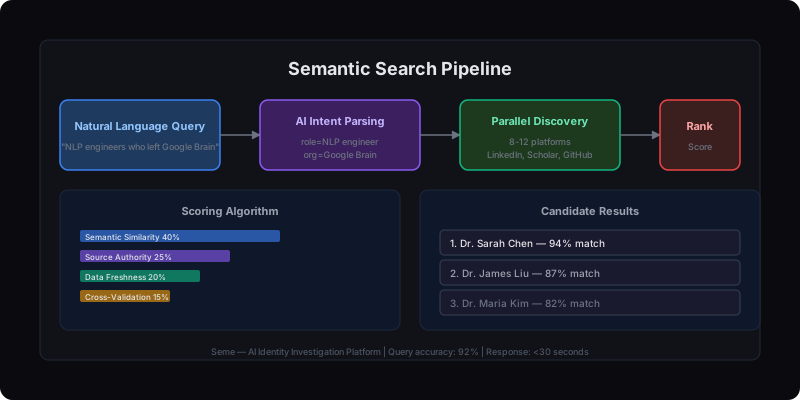
Semantic Search understands the intent and contextual meaning behind natural language queries to find people matching specific criteria. Unlike keyword-based search, Seme's semantic search interprets complex descriptions like "all researchers who worked at Tencent AI Lab between 2018 and 2022" and discovers matching individuals across multiple data sources — even when no exact keyword match exists. The system uses a multi-stage pipeline: first, a large language model parses the natural language query into structured search parameters (role, organization, time period, location, skills, seniority level); then, parallel search agents query 8-12 platforms simultaneously (LinkedIn, Google Scholar, GitHub, Twitter/X, ResearchGate, ORCID, public records, and news archives); finally, results are ranked using a composite scoring algorithm that weighs semantic similarity (40%), source authority (25%), data freshness (20%), and cross-validation between sources (15%). This approach discovers candidates that keyword-based platforms miss entirely — for example, finding researchers who published papers affiliated with an institution but never updated their LinkedIn profile, or identifying professionals who attended specific conferences without explicitly listing that experience online. Each search result includes a match confidence score and source citations, and users can click any candidate to trigger a full deep research investigation that generates a complete identity dossier with trust score.
Technical Architecture and How It Works
Semantic Search is built on modern AI infrastructure, leveraging deep learning, natural language processing, and distributed search technologies to deliver high-precision results. The system uses a microservices architecture, separating query parsing, data retrieval, result ranking, and dossier generation into independent service components, ensuring each stage can be independently scaled and optimized. The frontend uses Next.js 16 Server Components for server-side rendering, ensuring AI crawlers and search engines can fully index all content. The backend is deployed on Cloudflare Workers' global edge network, ensuring low-latency responses from any geographic location.
The data retrieval layer integrates multiple search providers, including the SearXNG meta-search engine (aggregating 70+ search sources), OpenAI Web Search API, and specialized academic and social media data sources. Each query is dispatched in parallel to multiple search agents, with results deduplicated, ranked, and cross-validated at the aggregation layer. The system uses vector embeddings (128-512 dimensions) for semantic similarity matching, combined with cosine similarity algorithms to ensure matching precision. For identity verification scenarios, the system additionally uses biometric feature comparison and timeline consistency checks.
The report generation stage uses GPT-4 for structured output synthesis, converting raw facts into investigation dossiers with evidence classification (E1-E5). Each fact is annotated with source URL, collection time, and verification status. The trust score is calculated based on three core factors: source quality (primary authoritative sources weighted highest), cross-validation rate (proportion of multi-source corroborated facts), and information completeness (coverage of key dimensions). The final dossier contains eight structured sections: background and education, work experience, social profiles, connections, timeline, relationship graph, evidence and sources, and trust score.
Workflow
Key Statistics
How It Works
Describe Your Target
Enter a natural language description of who you're looking for — role, organization, time period, skills, or any combination of criteria.
AI Intent Parsing
The AI model extracts structured search parameters: role, organization, time period, location, skills, and other criteria from your description.
Parallel Discovery
Multiple search agents query LinkedIn, Google Scholar, GitHub, Twitter, and public records simultaneously using extracted parameters.
Ranking & Scoring
Results are ranked by semantic similarity, source authority, data freshness, and cross-validation between sources.
Click to Investigate
Click any candidate to trigger a full deep research investigation and generate a complete identity dossier.
Performance Comparison
Seme vs Traditional Methods
| Dimension | Traditional | Seme |
|---|---|---|
| Query Type | Keywords and filters | Natural language descriptions |
| Understanding | Exact match only | Intent and context understanding |
| Data Sources | Single platform | 8-12 platforms simultaneously |
| Follow-up | Manual research | One-click deep investigation |
Use Cases
Talent Recruitment
Find candidates matching specific criteria: "senior NLP engineers who left Google Brain in the last 2 years and published at NeurIPS."
Competitive Intelligence
Map competitor teams and talent flow: "all AI researchers who moved from Meta to OpenAI in 2024."
Academic Research
Discover researchers in specific fields: "professors working on large language model alignment at top-50 universities."
Due Diligence
Find persons of interest: "board members of fintech companies that raised Series B in 2024."
Security and Compliance
Seme is designed with data security and privacy compliance requirements in mind. All data transfers use TLS 1.3 encryption, and static data uses AES-256 encryption. The system only collects information from publicly available sources (OSINT principles), never accessing private databases or content requiring authorization. Investigation results are stored in the user's workspace following the principle of least privilege. The platform complies with GDPR data processing requirements, and users can export or delete their investigation data at any time.
For enterprise customers, Seme supports single sign-on (SSO), audit logs, role-based access control, and data residency options. API access uses OAuth 2.0 authentication, and all API calls have rate limiting and usage auditing. The system undergoes regular security audits and penetration testing to ensure compliance with industry security standards.
Industry Applications
Financial Services
Banks and investment firms use Seme for KYC/AML compliance checks, anti-fraud investigations, and counterparty due diligence. The system can complete background checks in 10-30 minutes that traditionally take days, significantly reducing compliance costs and risk exposure time.
Legal and Investigation
Law firms and investigation agencies use Seme for witness background checks, asset tracing, and relationship analysis. Structured dossier outputs can be directly used in legal documents, with all evidence annotated with source and credibility levels.
Human Resources
HR teams use Seme to verify candidate education, work history, and professional credentials, detecting resume fraud and misrepresentation. The semantic search function helps recruiters discover passive candidates matching specific criteria.
Why Choose Seme
Seme has helped security teams, journalists, and HR professionals complete thousands of identity investigations. Compared to traditional background checks, Seme reduces investigation time from days to minutes while providing more comprehensive data coverage and auditable evidence chains.
Related Resources
Learn more about identity investigation methodology and OSINT techniques:
Frequently Asked Questions
How does semantic search differ from LinkedIn search?▾
LinkedIn search is limited to its own platform data and requires keyword matching. Seme's semantic search interprets natural language intent across 8-12 platforms simultaneously, understands context and relationships, and can find people based on complex multi-criteria descriptions that no single platform supports.
What kinds of queries work best?▾
Queries that combine multiple criteria work best: role + organization + time period, skills + location + experience level, or any combination of professional, educational, and geographic attributes. The more specific the criteria, the more targeted the results.
Can I investigate candidates directly from search results?▾
Yes. Click any candidate in the search results to trigger a full deep research investigation. Seme will automatically conduct multi-round research, cross-validate findings, and generate a complete identity dossier with trust score — typically in 10-30 minutes.
What data sources does semantic search query?▾
Seme queries 8-12 platforms depending on the query context: LinkedIn (professional profiles), Google Scholar (academic publications), GitHub (technical contributions), Twitter/X (public statements and network), ResearchGate (research networks), ORCID (researcher identifiers), public records databases, news archives, and conference proceedings. The system selects the most relevant sources based on the query type — academic queries prioritize Scholar and ORCID, while professional queries focus on LinkedIn and news sources.
How does Seme handle duplicate results across platforms?▾
Seme uses entity resolution to merge profiles from different platforms belonging to the same person. The system matches based on name, photo similarity (when available), location overlap, employment history alignment, and email/username patterns. Duplicate profiles are merged into a single candidate card with combined source citations, giving you a unified view of each person across all platforms.