Use Cases
Learn how Seme provides AI-powered identity investigation capabilities across industries and scenarios.
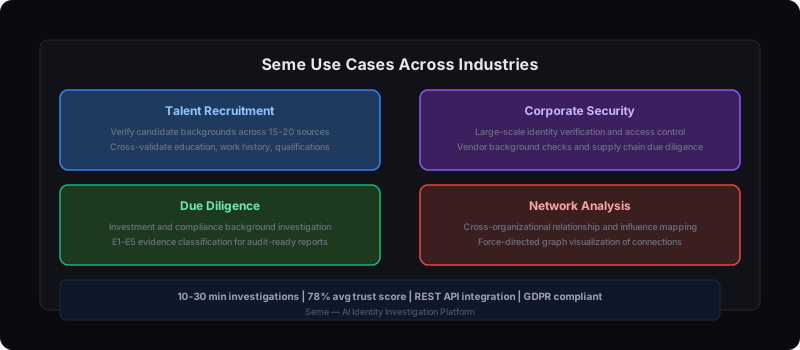
Traditional identity investigation methods typically rely on manual review of limited data sources, taking days to weeks and prone to human oversight. Seme's AI-driven approach automates multi-round search, cross-validation, and structured report generation, reducing investigation time from days to 10-30 minutes while covering more data sources and providing an auditable evidence chain. Each use case is optimized for specific industry requirements with customized investigation templates and report formats.
Seme's use cases span four major domains: talent recruitment, corporate security, due diligence, and network analysis. In talent recruitment, the system cross-validates candidate education, work history, and professional qualifications across 15-20 independent sources. In corporate security, the platform supports large-scale identity verification and vendor background checks. In due diligence, Seme collects target information from public records, corporate registries, and news archives, annotating credibility with the E1-E5 evidence classification system. In network analysis, the system builds cross-organizational relationship network graphs by analyzing co-authored projects, co-published papers, and co-attended events. All use cases provide REST API interfaces for automated workflow integration.
Talent Recruitment
Verify candidate backgrounds with comprehensive data
AI-powered identity investigation for talent recruitment goes beyond traditional background checks. Seme verifies employment history across 3+ companies, confirms academic degrees, checks for criminal records, validates professional certifications, and analyzes digital presence — all with source-cited evidence and a quantified trust score. Reduce hiring risk and verify candidate claims in minutes instead of days. Traditional background checks typically verify 5-10 data points from 1-3 databases, taking 3-7 business days and costing $50-200 per candidate. Seme's AI-powered investigation verifies 25-50 data points across 15-20 independent sources in 10-30 minutes, providing a comprehensive view that includes professional reputation analysis, publication verification, conference attendance records, open source contributions, and social media presence assessment. The system automatically detects red flags such as resume inconsistencies (claimed titles that don't match LinkedIn history), education verification failures (degrees from unaccredited institutions or diploma mills), undisclosed conflicts of interest (board positions at competitor companies), and concerning online behavior. For technical hires, Seme can verify GitHub contribution patterns, published research papers, and patent filings — data points that traditional background checks never cover.
Corporate Security
Identity verification and insider threat detection
Corporate security teams use Seme for large-scale identity verification, insider threat assessment, and access control. The platform combines facial recognition, deep research investigation, and network analysis to verify identities, detect potential security risks, and map organizational relationships. From vendor verification to employee monitoring, Seme provides the intelligence layer for modern corporate security operations. The platform addresses three critical security workflows: vendor onboarding (verifying company principals, checking sanctions lists, and detecting shell company structures), insider threat monitoring (detecting undisclosed outside activities, competitor contacts, and behavioral anomalies among employees with access to sensitive data), and access control (verifying identities at facility entry points using facial recognition against known databases and watchlists). Seme's network analysis capability maps relationships between employees, external entities, and potential threat actors using graph theory algorithms including centrality analysis (identifying key influencers), community detection (finding clusters), and path analysis (discovering connection routes). For enterprise deployments, the platform supports SSO integration, audit logs, role-based access control, and data residency options to meet corporate security requirements.
Due Diligence
In-depth background investigation for investment and compliance
Modern due diligence combines traditional database checks with AI-powered OSINT investigation. Seme verifies employment and education credentials, checks criminal and litigation records, analyzes digital presence and reputation, maps professional networks, and identifies undisclosed conflicts of interest — all with source-cited evidence and quantified confidence scores. Essential for investment decisions, M&A transactions, and regulatory compliance. Seme offers a three-tier investigation approach: Tier 1 (Automated Screening) queries government databases, sanctions lists, criminal records, court filings, and corporate registries for baseline risk assessment; Tier 2 (OSINT Investigation) adds comprehensive digital footprint analysis, social media presence evaluation, professional network mapping, media coverage review, and public records search; Tier 3 (Deep Research) adds multi-round AI investigation with cross-validation for high-stakes decisions. For investment due diligence, the system specifically verifies claimed exits (checking SEC filings, press releases, and acquisition records), validates board positions (cross-referencing corporate registries and LinkedIn), checks litigation history (searching court databases across jurisdictions), and identifies undisclosed conflicts of interest (mapping connections to portfolio companies and competitors). The structured output includes a risk assessment matrix with quantified confidence scores for each verified claim, making it directly usable in investment committee presentations and compliance filings.
Network Analysis
Map relationships and influence networks
Network Analysis maps professional relationships, organizational affiliations, and social connections using graph theory. Seme builds knowledge graphs from investigation data, then applies centrality analysis (identifying key influencers), community detection (finding clusters), and path analysis (discovering connection routes). Essential for understanding organizational structures, influence patterns, and hidden relationships in corporate, investment, and investigative contexts. The system constructs knowledge graphs where entities (persons, organizations) are nodes and relationships (employment, board membership, co-authorship, investment, social connections) are edges with typed attributes. Four key graph metrics are calculated: degree centrality (number of direct connections — identifies well-connected individuals), betweenness centrality (how often an entity bridges other entities — identifies information brokers and gatekeepers), clustering coefficient (how interconnected an entity's contacts are — identifies tight-knit groups), and eigenvector centrality (connection quality based on the importance of connected entities — identifies influence). For fraud detection, the system applies community detection algorithms to identify coordinated groups, shell company networks, and undisclosed relationships between entities. For competitive intelligence, path analysis reveals shortest connection routes between any two entities, useful for identifying warm introduction paths or mapping competitor organizational structures. The force-directed graph visualization renders up to 500 nodes with interactive filtering by relationship type, entity category, and connection strength.
Platform Data
Seme's investigation methodology is based on OSINT best practices, combining AI automation with structured analysis. Each use case is optimized for specific industry requirements with customized investigation templates and report formats. The platform complies with GDPR data processing requirements and all operations have complete audit logs.
Related Resources
- Core Features — Technical details on Face Search, Semantic Search, and Deep Research
- Investigation Methodology — Learn about the five-step investigation process and evidence classification system
- Comparison Analysis — Detailed comparison of Seme vs traditional methods
- Pricing — Free, Pro, and Enterprise plans
Frequently Asked Questions
What are Seme's use cases?▾
Seme serves four core use cases: Talent Recruitment, Corporate Security, Due Diligence, and Network Analysis. Each leverages the same multi-source investigation engine but focuses on different data dimensions and output formats.
How is Seme used for talent recruitment?▾
Seme cross-validates candidate education, work history, and qualifications across 15-20 independent sources, identifies resume inconsistencies, and generates structured reports with trust scores.
How is Seme used for due diligence?▾
In investment and compliance due diligence, Seme collects information about target individuals or entities from public records, corporate registries, news archives, and social platforms, annotates each finding with E1-E5 evidence classification, and generates auditable investigation reports.
Are Seme's data sources secure?▾
Seme only collects information from publicly available sources (OSINT), never accessing private databases or protected content. All investigation operations have complete audit logs, and the platform complies with GDPR data processing requirements.
Get Started with Seme
Try AI-powered identity investigation for free. Ideal for talent recruitment, corporate security, due diligence, and more.