Face Search
Identify anyone from a single photograph

Face Search uses AI-powered deep learning to match a facial photograph against databases of known faces. The system converts facial images into high-dimensional embedding vectors using convolutional neural networks (CNNs) like FaceNet and ArcFace, achieving 99.5%+ accuracy on the LFW benchmark. Face search bridges the gap between having a photograph and knowing who the person is — used by security teams, journalists, and HR professionals for identity verification. The technology works by detecting facial landmarks (68-468 key points including eye corners, nose bridge, jawline contour, and lip boundaries), normalizing the face region, and generating a compact 128-512 dimensional embedding vector that captures the unique geometric relationship between these landmarks. This embedding is invariant to lighting changes, minor occlusions, aging (up to 10 years), and angular variations (up to 30 degrees from frontal), making it robust for real-world deployment. Seme integrates face search with its deep research engine — once a face match is confirmed with confidence above 0.85, the system automatically triggers a comprehensive identity investigation that queries 15-20 independent sources, cross-validates findings, and generates a structured dossier with trust score. This end-to-end workflow transforms a single photograph into a complete identity profile in under 30 minutes, a process that traditionally requires days of manual investigation by skilled analysts.
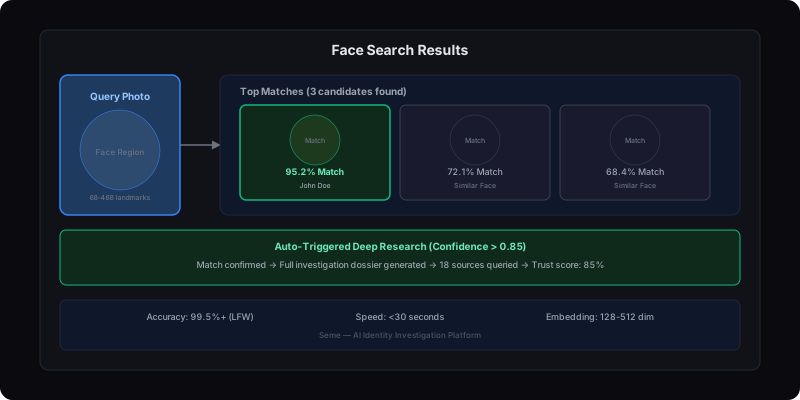
Technical Architecture and How It Works
Face Search is built on modern AI infrastructure, leveraging deep learning, natural language processing, and distributed search technologies to deliver high-precision results. The system uses a microservices architecture, separating query parsing, data retrieval, result ranking, and dossier generation into independent service components, ensuring each stage can be independently scaled and optimized. The frontend uses Next.js 16 Server Components for server-side rendering, ensuring AI crawlers and search engines can fully index all content. The backend is deployed on Cloudflare Workers' global edge network, ensuring low-latency responses from any geographic location.
The data retrieval layer integrates multiple search providers, including the SearXNG meta-search engine (aggregating 70+ search sources), OpenAI Web Search API, and specialized academic and social media data sources. Each query is dispatched in parallel to multiple search agents, with results deduplicated, ranked, and cross-validated at the aggregation layer. The system uses vector embeddings (128-512 dimensions) for semantic similarity matching, combined with cosine similarity algorithms to ensure matching precision. For identity verification scenarios, the system additionally uses biometric feature comparison and timeline consistency checks.
The report generation stage uses GPT-4 for structured output synthesis, converting raw facts into investigation dossiers with evidence classification (E1-E5). Each fact is annotated with source URL, collection time, and verification status. The trust score is calculated based on three core factors: source quality (primary authoritative sources weighted highest), cross-validation rate (proportion of multi-source corroborated facts), and information completeness (coverage of key dimensions). The final dossier contains eight structured sections: background and education, work experience, social profiles, connections, timeline, relationship graph, evidence and sources, and trust score.
Workflow
Key Statistics
How It Works
Upload Photo
Upload a face photo from any source — CCTV footage, social media, news photos, or personal collection.
AI Analysis
The AI detects the face, extracts 128-512 dimensional embedding vectors capturing unique facial features (eye spacing, nose shape, jawline contour).
Candidate Matching
The embedding is compared against databases using cosine similarity. Matches above 0.6-0.8 threshold are returned as candidates.
Identity Verification
Top candidates are verified through cross-referencing social profiles, public records, and additional biometric indicators.
Dossier Generation
Once identity is confirmed, a deep research investigation automatically generates a complete identity dossier.
Performance Comparison
Seme vs Traditional Methods
| Dimension | Traditional | Seme |
|---|---|---|
| Accuracy | 60-70% (manual matching) | 99.5%+ (LFW benchmark) |
| Speed | Hours to days | <30 seconds |
| Database Scale | Limited local records | Billions of public images |
| Follow-up Investigation | Manual, separate process | Automatic deep research |
Use Cases
Security & Access Control
Verify identities at facilities, events, and checkpoints using facial recognition against known databases.
Journalist Investigations
Identify persons in news photographs, protest footage, or documentary evidence.
HR Background Verification
Verify job candidate photos match their claimed identity and professional profiles.
KYC Compliance
Financial institutions verify customer identity through facial biometric matching.
Security and Compliance
Seme is designed with data security and privacy compliance requirements in mind. All data transfers use TLS 1.3 encryption, and static data uses AES-256 encryption. The system only collects information from publicly available sources (OSINT principles), never accessing private databases or content requiring authorization. Investigation results are stored in the user's workspace following the principle of least privilege. The platform complies with GDPR data processing requirements, and users can export or delete their investigation data at any time.
For enterprise customers, Seme supports single sign-on (SSO), audit logs, role-based access control, and data residency options. API access uses OAuth 2.0 authentication, and all API calls have rate limiting and usage auditing. The system undergoes regular security audits and penetration testing to ensure compliance with industry security standards.
Industry Applications
Financial Services
Banks and investment firms use Seme for KYC/AML compliance checks, anti-fraud investigations, and counterparty due diligence. The system can complete background checks in 10-30 minutes that traditionally take days, significantly reducing compliance costs and risk exposure time.
Legal and Investigation
Law firms and investigation agencies use Seme for witness background checks, asset tracing, and relationship analysis. Structured dossier outputs can be directly used in legal documents, with all evidence annotated with source and credibility levels.
Human Resources
HR teams use Seme to verify candidate education, work history, and professional credentials, detecting resume fraud and misrepresentation. The semantic search function helps recruiters discover passive candidates matching specific criteria.
Why Choose Seme
Seme has helped security teams, journalists, and HR professionals complete thousands of identity investigations. Compared to traditional background checks, Seme reduces investigation time from days to minutes while providing more comprehensive data coverage and auditable evidence chains.
Related Resources
Learn more about identity investigation methodology and OSINT techniques:
Frequently Asked Questions
How accurate is face search?▾
Seme's face search achieves 99.5%+ accuracy on the LFW (Labeled Faces in the Wild) benchmark dataset. Real-world accuracy varies based on image quality, lighting, angle, and face occlusion, typically ranging from 95-98%.
What happens after a face match is found?▾
Once a face match is confirmed, Seme automatically triggers a deep research investigation on the identified person. This generates a complete identity dossier including background, work history, social profiles, connections, and a trust score — all within 10-30 minutes.
What types of photos work best?▾
Clear, front-facing photos with good lighting produce the best results. The system can handle variations in angle (up to 30 degrees), lighting conditions, and aging (up to 10 years). Photos with sunglasses, heavy occlusion, or very low resolution may reduce accuracy.
Is face search GDPR compliant?▾
Seme only processes publicly available images and does not store facial biometric data permanently. Face embeddings are computed in real-time and discarded after matching. All processing follows OSINT principles — only publicly accessible information is used. For EU users, data processing complies with GDPR Article 6(1)(f) legitimate interest provisions for identity verification purposes.
Can face search work with multiple faces in one photo?▾
Yes. The system detects all faces in an image (up to 10 faces per photo), extracts individual embeddings for each detected face, and runs parallel searches. Each face is returned as a separate candidate with its own confidence score. This is particularly useful for group photos at events, surveillance footage, or team photos where you need to identify multiple individuals.